
Coface publishes the 10th edition of its Corporate Payment Survey in Germany, conducted among 503 companies. While economic growth is gradually returning and German businesses are becoming more optimistic about 2027, this improvement has yet to translate into better payment behavior. 82% of companies experienced payment delays over the past twelve months, the highest level since 2019. At the same time, businesses are shortening payment terms to protect their cash flow, while long overdue payments and rising insolvencies continue to point to elevated credit risk.
Key figures
- 82% of German companies experienced payment delays in 2026
- The average payment delay fell to 30.2 days (31.8 days in 2025), while average payment terms shortened from 32.5 to 30.6 days, their lowest level since 2017.
- Coface expects corporate insolvencies to rise by a further 5% in 2026, with credit risk remaining elevated into 2027.
Payment delays at their highest level since 2019
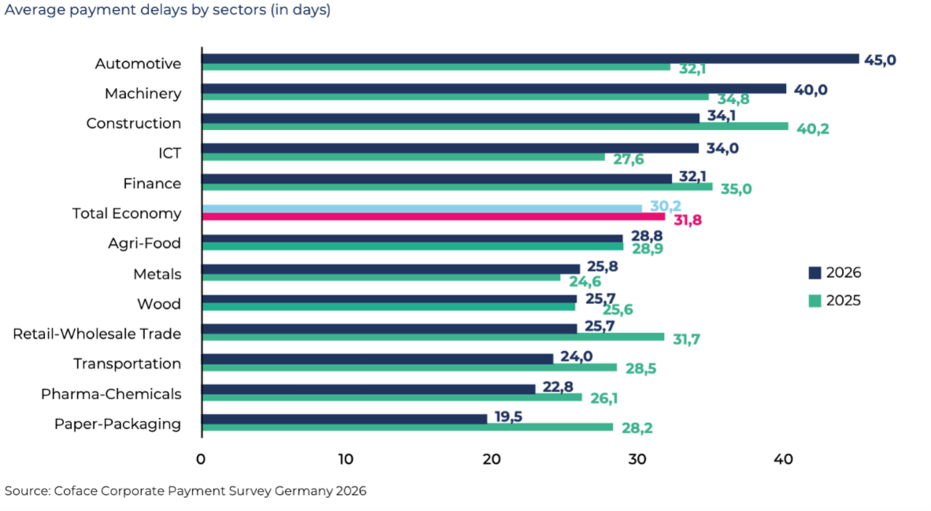
Late payments are becoming more widespread. 82% of German companies experienced payment delays during the past twelve months, the highest proportion recorded since 2019. However, the average duration of payment delays has shortened to 30.2 days, from 31.8 days in 2025 and almost 40 days before the Covid pandemic. The automotive sector stands out, with an average payment delay of 45 days, while paper and packaging records the shortest average delay, at 19.5 days.
Data used for the graph in .xlsx format
Financial difficulties among customers remain the leading cause of late payments. A potential domino effect is emerging across the German economy: 33% of companies point to late payments from their customers’ own clients, suggesting payment difficulties are cascading through the economy.
Long overdue payments and insolvencies point to persistent credit risk
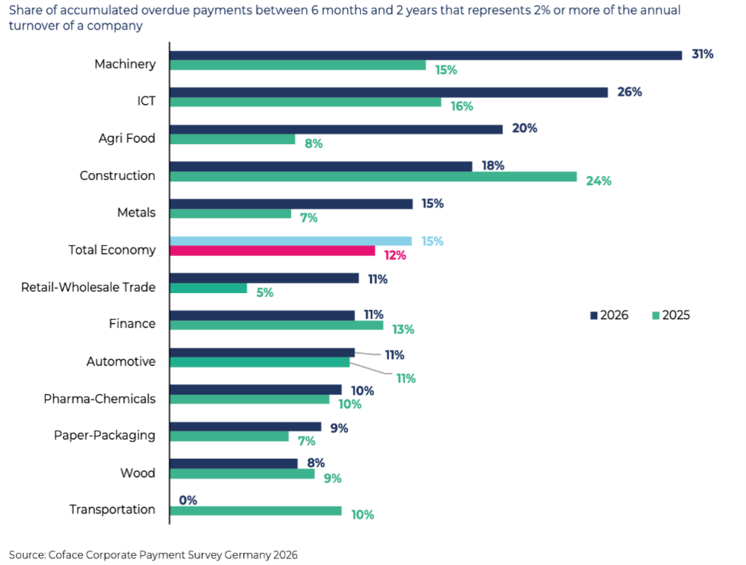
Beyond the frequency of late payments, the increase in long overdue receivables is another warning signal. 15% of companies report that payments overdue between 6 and 24 months, represent at least 2% of their annual turnover. Smaller companies are particularly exposed to this trend.
Data used for the graph in .xlsx format
This coincides with rising corporate insolvencies. The number of insolvencies in Germany has been on an upward trend since 2022, and Coface's anticipates a further 5% increase in 2026, with elevated levels expected to persist into 2027.
2027 : cautious optimism, but risks remain elevated
Despite persistent payment risks, German companies are somewhat more confident about the year ahead. While more companies report a deterioration in business conditions in 2026, expectations are more positive for 2027: 25% expect business conditions to improve, compared with only 15% anticipating a deterioration, while45%expect conditions to remain unchanged.
This optimism is primarily domestic. 74% of respondents identify Germany as the market offering their biggest business opportunity in 2027. EU and EFTA countries also rank highly, while the United States and China have become significantly less attractive: only 4% identify the US and 1% China as their main opportunity, against a backdrop of newly implemented US tariffs and strong domestic competition in China.
The main risks are also predominantly domestic. 28% cite location-related difficulties, including high costs and excessive bureaucracy, as the main obstacle to their success, followed by weak domestic demand (20%) and political uncertainty (17%).
While GDP growth could support improved payments in 2027, Germany's economic performance relies mostly on fiscal measures. The risk of late, or non-payment, is expected to remain elevated in 2027.
> To learn more about Germany's Corporate Payment, download the full survey.


